On The Nature
of Money
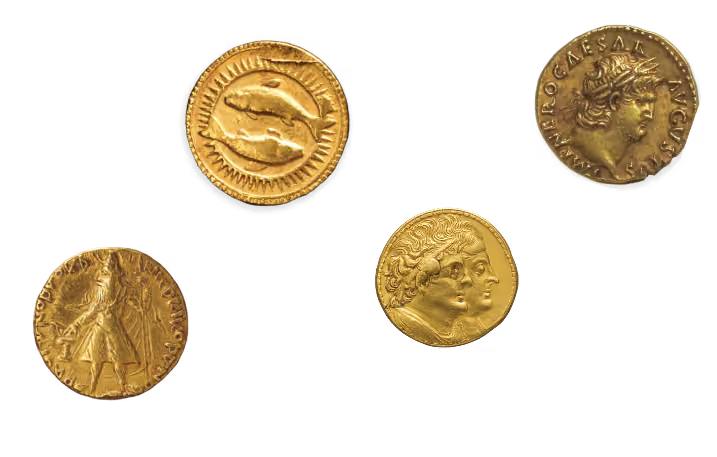
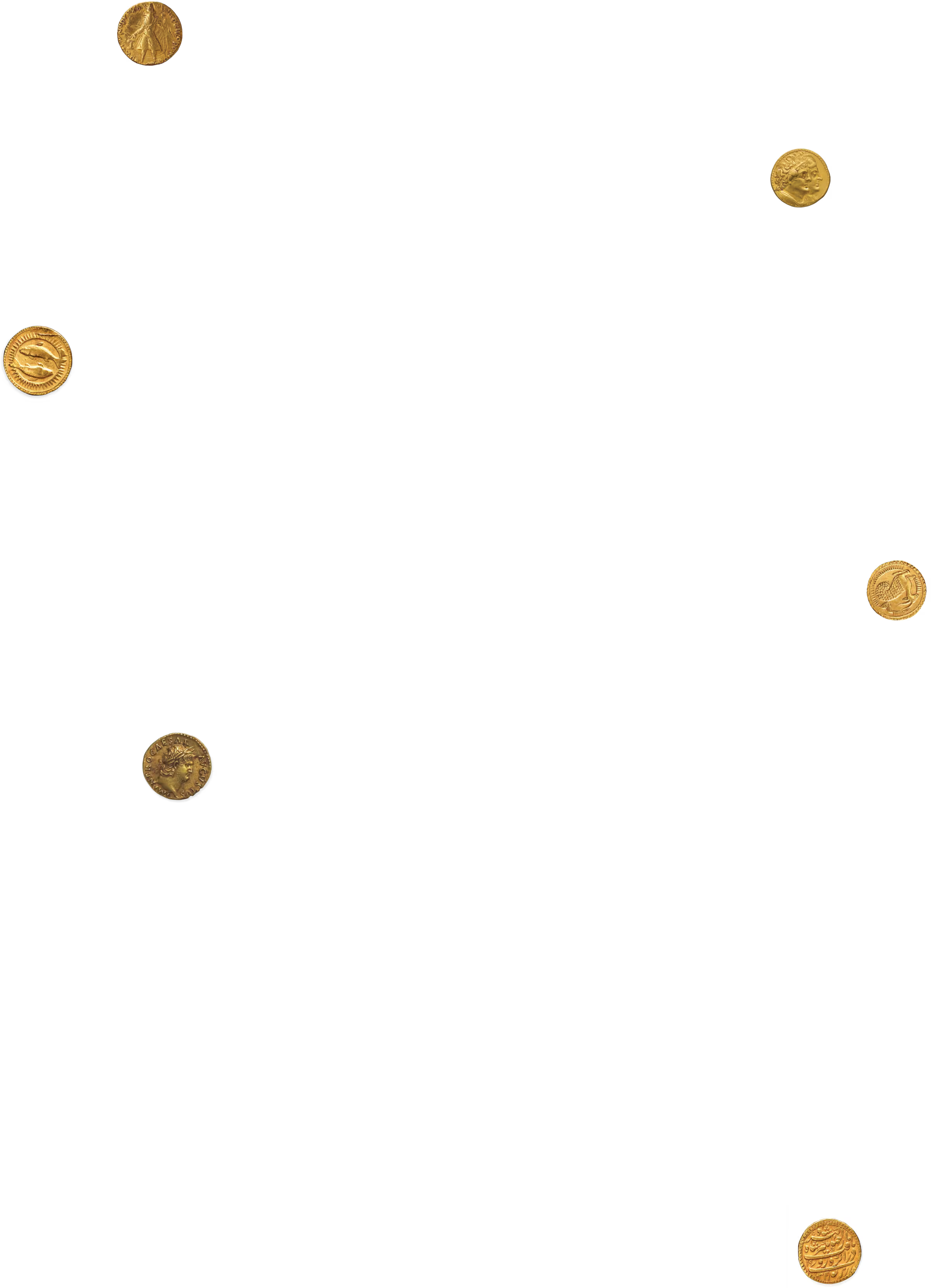
Utukku lemnutu, tablet, 12
Seleucid ca. late 1st millennium BC
dated 1027 AH/1618 CE
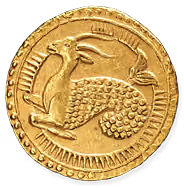
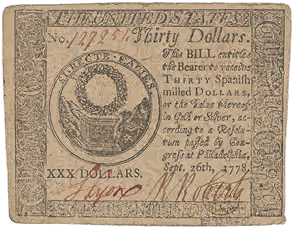
Associated with Cyrus Durand
American Printer
A. B. & C.
Durand & Company American
Printer Durand, Perkins, and
Company American
ca. 1824–42
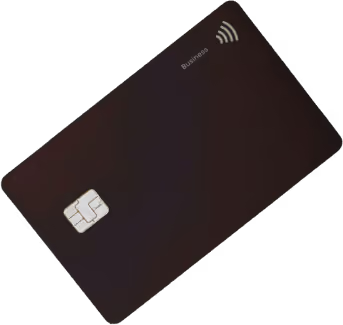
1950s
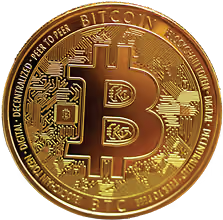
2008

Utukku lemnutu, tablet, 12
Seleucid ca. late 1st millennium BC
dated 1027 AH/1618 CE
Associated with Cyrus Durand
American Printer
A. B. & C.
Durand & Company American
Printer Durand, Perkins, and
Company American
ca. 1824–42
1950s
2008
“Five thousand years after the clay tablets, money had quietly returned to its original form.”
Anyone who has opened The Wealth of Nations or any economics textbook is familiar with Adam Smith's fable. The butcher has more meat than he can eat. The brewer and the baker would each happily take some, but all they can offer is beer and bread, and the butcher has plenty of both. Because of this double coincidence of wants, the deal dies. Money, Smith reasoned, was invented to fix this conundrum: something everyone accepts, so these deals can simply flow. It's a neat and tidy story: first came bartering, then came coins, then came paper, and finally credit arrived, each stage elegantly solving the frustrations of the last.
But Caroline Humphrey would heatedly disagree with Adam Smith. In 1985, the Cambridge anthropologist put it bluntly: no example of money originating from a barter economy has ever been found. A. Mitchell Innes said as much when he wrote, "nothing but history can confirm the accuracy of our reasoning, and if our theory cannot stand the test of history, then there is no truth in it" in the Banking Law Journal in 1913¹. What the archaeology shows instead is that money began in the form any banker would recognize immediately. It began as a ledger.
¹ A. Mitchell Innes, "What is Money?" The Banking Law Journal 30 (May 1913), p. 155. The concept was further expanded in his 1914 follow-up paper, "The Credit Theory of Money."
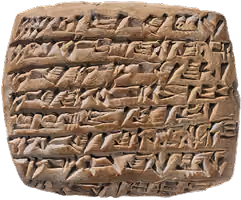
The oldest financial records we have are Mesopotamian clay tablets recording debts, some more than four thousand years old. They are far from primitive. They specify principal, term, and rate: under the Code of Hammurabi, roughly 3,800 years ago, the legal ceiling was 20% on silver loans and 33.3% on barley. Silver and grain served as units of account. Coins did not exist, but no one missed what they didn't know. The token arrived two thousand years later.
The token first emerged in Lydia, in western Anatolia, around 630 BCE. Before coins, paying in metal meant weighing the lump and testing its purity at every transaction. The Lydian mint did that work a single time. They created standardized pieces of electrum, a natural gold-silver alloy that washed out of Lydian rivers, each stamped with the king's lion as a guarantee of what it weighed. Coins are a technology of convenience. They let strangers transact without a shared ledger, which made them ideal for the two institutions that show up uninvited: armies and tax collectors.
Paper was a genius solution to a regional problem. In 1024, Sichuan's economy ran on iron coinage so heavy that a workable sum weighed as much as a cargo load. The Song government's solution? Issuing jiaozi, the first state paper money, against deposits of coin. When Marco Polo saw the Great Khan's mulberry-bark notes two and a half centuries later, he reported it as something akin to alchemy.
Europe took another 350 years to catch up: Stockholms Banco issued the first European banknotes in 1661, over-issued them, collapsed within the decade, and left behind the institution that became the world's oldest central bank. The first paper money and the first paper-money crisis arrived in tandem.
Merchants of the Islamic world were writing sakk (some historians trace this as the etymological origin of "check") and sending suftaja, letters of credit, across the Sahara and the Indian Ocean by the ninth century, so that the money traveled as information while only the sakk made the trip. American check volume peaked around 1995 at roughly 49 billion units a year. Then it fell precipitously.
You don't often see material science and payments processing in the same sentence. But as it turns out, plastic is what made the credit card truly scalable. Diners Club started charging dinners to cardboard in 1950 with 27 restaurants signed up. Bank of America knew it was on to something and skipped persuasion entirely: in September 1958 it mailed roughly 60,000 unsolicited credit cards to the residents of Fresno, California, each preloaded with several hundred dollars of credit. The Fresno Drop became Visa. While the fraud losses were something to behold, the business model survived them.
By the time the ATM (Enfield, London, 1967) and SWIFT (1973) arrived, actual physical artifacts of money had already become a rounding error. The Bank of England reported in 2014 that about 97 percent of money in the UK exists only as commercial bank deposits: entries in databases, transferable on instruction. Five thousand years after the clay tablets, money had quietly returned to its original form. The ledgers were simply private now, and banks were the ones holding the stylus.
Which is the context in which Bitcoin and now, stablecoins, are worth understanding. The hard problem of digital cash was double-spending: a digital token is data, and data copies. Every earlier attempt, including David Chaum's cryptographically elegant DigiCash in the 1990s, solved it with a trusted central party, which is to say, with a bank; DigiCash went bankrupt in 1998.
The white paper Satoshi Nakamoto published on October 31, 2008 solved it differently: make the ledger public, let the whole network hold the same copy, and settle by consensus. The first block, mined January 3, 2009, carried that day's Times headline about a second bank bailout.
Strip away the price charts and the ideology and the design choice is an old one. Confronted with the problem the clay tablets solved, Nakamoto reached for the same answer: money is a shared record of who owes what to whom.