Fintech Fiasco
Blue Ridge Bank spent two years as the industry's favorite cautionary tale, escaping its consent order in record time. Then it was sold for less than a quarter of its prior value.
Here's what happened.
By David Richards


Billy Beale was seventy-three years old and two retirements deep when Blue Ridge Bank came calling in the spring of 2023. He had spent twenty-six years running Union Bank & Trust of Richmond, taking it from $180 million in assets to the $8.5 billion institution now called Atlantic Union, the largest regional bank headquartered in Virginia. He had already been coaxed back to work once, to steady a small bankers' bank for two years, and had returned to retirement presumably for good. Then came the inciting incident for the epic conclusion of a trilogy he never planned for. It was a $3.1 billion community bank with seventy financial-technology companies riding on its charter, a federal regulator already in the building, and a stock in freefall asking for help. His mandate, as he later described it, consisted of just four words. "Clean the thing up."
He did. It took thirty months, $150 million of other people's money, and the termination of every last one of those seventy partnerships. On November 13, 2025, the Office of the Comptroller of the Currency released Blue Ridge from its consent order in less than twenty-three months; a near-record time. The bank was profitable again. Beale retired for the third time in March 2026, at seventy-six years of age.
Five months later, the board sold the bank.
On August 17, 2026, HomeTrust Bancshares of Asheville, North Carolina, agreed to acquire Blue Ridge for $448.1 million in stock at announcement, or $4.28 a share, against a peak of $18.57. The name, on a Virginia charter in one form or another since 1893, is rumored to be retired. The industry has been telling Blue Ridge's story as a redemption arc, and every fact in that version is true: flew too close to fintech, got burned, hired a legend, got compliant in near-record time. But redemption arcs end with the hero restored, and this one ends with the company sold for less than a quarter of its former price and its name coming off the building. The cleanup succeeded, but the bank did not.
Seventy partners
For most of its 130 years Blue Ridge was exactly what it appeared to be: a small community lender from Luray, a Shenandoah Valley town best known for its charm and stalactites. Brian Plum, who joined as chief financial officer in 2006 and took over as chief executive in 2014, had bigger plans. He bought Virginia Community Bankshares in 2019 and pushed assets toward $1 billion. He listed the company on the NYSE that December. And in 2020 he found the accelerant: banking as a service (BaaS), the business of renting a bank's charter, deposit insurance, and regulatory standing to technology companies that had none of those.
His mandate, as he later described it, consisted of just four words.
"Clean the thing up."
The trade looked irresistible from both sides. The fintechs got the ability to acquire customers for a bank-like product without the pain and expense of becoming a bank themselves. Blue Ridge got deposits without building branches or spending money on marketing, and fee income without taking credit risk, or so the model promised. The first partners were infrastructure firms, Unit and Increase, and immediately the compliance load quickly overwhelmed the bank. Platforms like Unit did not bring one client; they brought ecosystems of them, batches of startups landing on Blue Ridge's books at software speed. More fintechs piled on top: the lender Upgrade, the payroll-advance firm Kashable, the credit-builder Grow Credit, the income-share student financier MentorWorks, a neobank called Aeldra opening American accounts for customers in India.
Blue Ridge was rewarded quickly. Fintech deposits grew rapidly from the 2020 launch, all the way to $690 million in two and a half years. The stock rose from $9 to $18.57 in a year. The champagne was flowing freely, but nobody thought about the impending hangover.
"Blue Ridge's partners were signing customers far faster than Blue Ridge was hiring anyone to watch them."
Those in banking are abundantly aware of this fact: the law is inflexible. In the regulator's eyes, every one of those seventy partners was Blue Ridge. Every account a fintech opened was Blue Ridge's to monitor; every dubious transaction moving through a partner's app was Blue Ridge's to catch, investigate, and report to the federal government. So while the deposits arrived overnight, the obligations did too, and obligations, unlike deposits, have to be met by actual people in an actual office in Virginia. Blue Ridge's partners were signing customers far faster than Blue Ridge was hiring anyone to watch them.
You only get two warnings
The first warning cost the bank a merger. In July 2021, at the top of its run, Blue Ridge announced a merger of equals with FVCBancorp of Fairfax, a deal that would have created one of the largest community banks in Virginia at roughly $5 billion in assets. Four months later the companies disclosed that the OCC had raised concerns with Blue Ridge and the deal would wait. By January 2022 it was terminated with no breakup fee and a joint statement that the boards had concluded it would not be prudent to proceed. Neither side said more. Bank mergers rarely dissolve because things are going well.
Seven months after that, the second warning arrived with a signature line. On August 29, 2022, Blue Ridge entered a written agreement with the OCC that read, for anyone fluent in banking, like a terminal diagnosis: no new fintech partners and no new products without the regulator's advance permission, a financial-crimes program that actually covered partner activity, independent audits of expanded scope, and a BSA department staffed with people equipped for the volume it was supervising. The subtext was short. The bank was on its way to seventy partners without the compliance function to oversee even a few.
Blue Ridge's leadership misread the agreement. They believed they could rightsize their compliance function, and in January 2023, they hired former Federal Reserve bank supervisor Kirsten Muetzel to lead their fintech division. In May, the board brought in Beale to run the bank. In June, the OCC arrived for its annual examination and saw a bank still carrying dozens of partners it could not fully see into. In July, Plum resigned and Beale took the holding company too. (Muetzel was gone by July as well.) On October 30, 2023, Blue Ridge suspended its dividend. Four days later the stock touched $2.23, down from $18.57 just twenty-five months earlier.
Seventy partners and what they cost
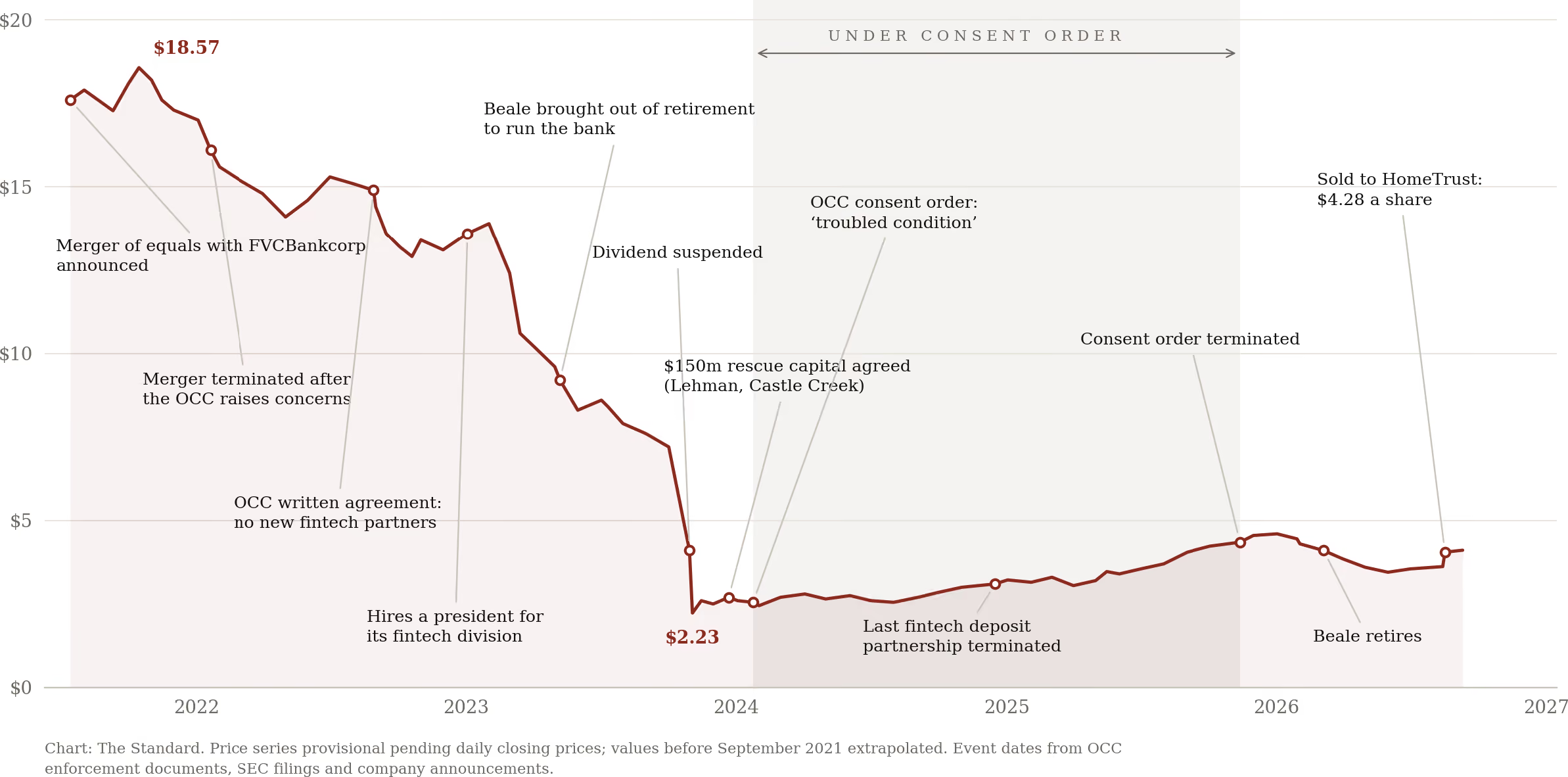
By then the retreat had already begun. Beale spent the fall offboarding partners, and by November the book was down to roughly fifty, with the bank telling investors it would keep only a limited number; the ones with a commercial focus or real consumer traction.
Fix-and-keep had become trim-and-keep. He spent the same months arranging a rescue, and on December 22 he had it: definitive agreements for a $150 million private placement led by Kenneth Lehman, an investor with a career built on recapitalizing troubled Virginia banks, alongside the bank-focused private equity firm Castle Creek. Survival secured, they thought.
Just thirty-three days later, on January 24, 2024, the OCC issued a formal consent order.
The order was built on the June 2023 exam, a moment-in-time snapshot of a bank that Beale insisted no longer existed; the order, he said at the time, was not reflective of the progress made since June. It did not matter. The order cited "systemic internal controls breakdowns, weak independent testing, and insufficient anti-money-laundering staffing," all traced to the fintech business, and directed the bank to staff the department with personnel of "requisite expertise, training, skills, and authority." It designated Blue Ridge a bank in "troubled condition," stripped its eligible-bank status so that even changing a senior executive now required notice to Washington. The order also set capital minimums of 10 and 13 percent, roughly double what a bank normally needs to count as well capitalized. And it took that label away regardless. Well capitalized is not a compliment. It provides permission to obtain brokered deposits, cheaper deposit insurance, and faster approvals. Blue Ridge now had to hold more capital than a healthy bank while paying the penalties of a sick one.
Blue Ridge posted a net loss of $51.8 million in 2023, a figure that owed less to fintech than the headlines suggested: $26.8 million was a write-off of the bank's entire goodwill balance, several million more settled litigation over an employee stock plan inherited with a 2019 acquisition, and $8.1 million after tax went to remediation, the consultants and auditors a consent order makes mandatory.
The bank lost another $15.4 million in 2024, including a $6.7 million after-tax write-down of a stake in a fintech partner. Compliance alone cost about $10 million in 2023, at a bank whose continuing operations had earned $17 million in their best year. The fintech business never came close to covering the cost of its own supervision.
The fixer
So trim-and-keep was dead too, and Beale replaced it with something more ruthless. If the business could not be supervised at seventy, and could not earn its keep at any number the bank could supervise, then the number was zero.
"We just threw BaaS out the door," he told American Banker later. Over the course of 2024 the bank ended every remaining fintech partnership; by December there were none left. That brought forth a brand new challenge. Since the fintechs' customers had kept their money at Blue Ridge, when the fintechs left, so did all of their deposits. To replace them, the bank had to buy deposits through brokers at higher rates, then spend most of 2025 paying that expensive funding back down. Despite this difficult ending to their fintech venture, Beale believed that, had Blue Ridge kept just three or four partnerships and run them properly, none of this would have happened.
While the partners went out one door, expensive new hires came in the other, and this is the part of the story Beale points to when asked how Blue Ridge escaped the consent order in under two years. He recruited risk and compliance officers from banks many times Blue Ridge's size, people who had run these functions at scale and knew what examiners needed to see: a Chief Risk Officer from OceanFirst Financial in New Jersey, a new Head of Financial Crimes Compliance, others behind them. The scarce resource in bank compliance turns out to be seasoned judgment, and it costs what it costs. The shareholders paid for all of it. The $150 million from Lehman arrived in April 2024 on brutal terms: sixty million shares plus warrants exercisable at $2.50, against a stock that had traded near $18 three years earlier. Lehman emerged holding roughly a quarter of the company. The investors who rode the fintech run up kept the losses and a sliver of whatever came next.
What came next was a smaller, plainer bank, shrinking on purpose. Assets fell from $3.1 billion to $2.43 billion by the end of 2025. Headcount dropped by 140 people, more than 30 percent, in a single year. The mortgage division was sold. Noninterest expenses fell from $113.8 million to $81.9 million. In 2025 Blue Ridge earned $10.7 million, its first profit since 2022, with capital levels that would have satisfied the consent order nearly twice over. On November 13 the OCC let go. Later, the bank paid shareholders a special dividend, its first cash since the suspension two years earlier, and it needed the regulator's sign-off to move the money. The dividend was twenty-five cents.
The next pitch
Blue Ridge's story is important because it became the type specimen for an entire enforcement wave. Between 2023 and 2025 the regulators worked through a who's who of fintech partner banks: Cross River, Green Dot, Lineage, Sutton, Choice, and, most consequentially, Evolve Bank & Trust, principal bank to the middleware firm Synapse, whose 2024 bankruptcy locked more than a hundred thousand fintech customers out of their money and left an $85 million hole between what the banks held and what depositors were owed. In 2023, banks in the fintech partner business drew 13.5% of the severe enforcement actions issued by federal regulators, per S&P Global Market Intelligence, despite numbering fewer than 2% of all banks in the US; by the first quarter of 2024, per Klaros Group data, more than a third of fintech partner banks had been hit with a formal action.
"With today's advances, would Blue Ridge be able to scale its compliance function with seventy partners?"
Out of that wreckage has come a comforting theory: that compliance, run properly, is a growth engine. The banks with the cleanest controls can grow fastest and Blue Ridge gets cited in support of it.
And the pitch arriving in bank boardrooms now concerns artificial intelligence, often presented as a capability the bank cannot build itself. This technology is different. The supervisory challenge is identical, and it finally enables the bank to easily supervise massive volumes of transactions with far fewer outsourced staff. The sad part to this story is, what if AI as banks are using it today had arrived five years earlier? With today's advances, would Blue Ridge be able to scale its compliance function with seventy partners? Perhaps they would.
But it didn't happen today, and Beale's arithmetic, three or four partners instead of seventy, was likely the right call. A bank that knows its supervisory capacity and grows within it can run a fintech business, or any business, indefinitely. A bank that grows past it has already made its choice; the letter just hasn't arrived. Blue Ridge's letter arrived, and the bank did everything right afterward, faster than nearly anyone, with better people and more capital than most troubled banks can attract. The best available outcome, at the end of all that work, was $4.28 a share and a name headed for retirement, on a charter that had previously survived two world wars and the Depression.
That same charter survived the consent order by just nine months.